
Tracing Former Owners of a Pike County Property
Work from the newest reliable source and step backward. The online index reaches 1970 in its date selector. That figure is not a promise of complete coverage from that year forward, though. Confirm the actual indexed depth for your parcel before trusting the early rows of a Pike County property records search.
| Source | Years It Covers | Where Held | What It Shows |
|---|---|---|---|
| RecordsUS deed index | 1970 is earliest selector observed; coverage not guaranteed | Pike Probate online and counter | Party names, instrument, date, book/page, image |
| Deed books and microfilm | Earlier county eras as surviving holdings allow | Probate, ADAH, affiliate-library resources | Earlier transfers and deed recitals |
| Recorded plats | Varies by subdivision and filing | Pike Probate | Lot/block, dedications, easements |
| Deed Book A abstract | 1826–1839 | Pike Historical Society resource | Indexed abstract of Pike's earliest identified land book |
Match the tool to the property's age. A recent house yields to the CAMA system and the online deed index. An older farm asks for section-township-range or metes-and-bounds details. Those details are carried into the physical deed books and plat maps. A named subdivision needs its phase, lot, block, and the recorded plat. The recorder holds that plat.
Reconstruct Past Owners from Pike's Index Rows
The official Pike deed index provides the modern search surface for the backward chain.
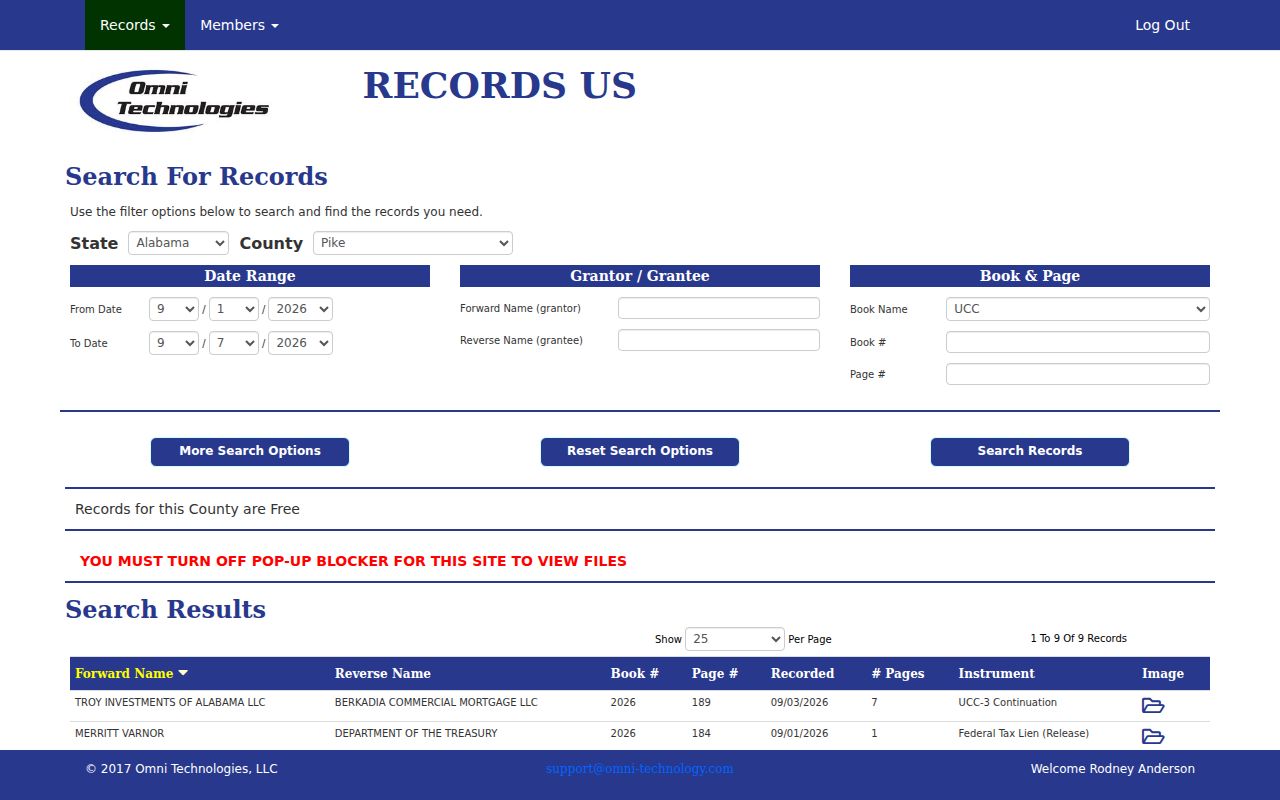
Index rows can show uppercase party names, the recorded date, the instrument type, book and page, and a page count. Optional subdivision, lot and block, legal description, township-range-section, and bearing fields help separate two deeds sharing a similar name. Images usually open through a folder or pop-up control. Allow the official site's window before deciding an image is missing from the deed records.
Go Back Through Estates, Initials, and Changed Names
Names hide former owners. Search the full indexed spelling. Then try initials, former surnames, trustee labels, executor phrases, and business suffixes. A transfer handled by a personal representative or trustee can break a simple seller-to-buyer pattern in the deed records. When an estate enters the chain, consult Pike County probate material. Keep in mind that Alabama vital records carry their own eligibility limits. For a company named on a deed, an Alabama Secretary of State entity filing shows the exact legal name. It also lists the registered agent. The filing still proves nothing about which parcel the entity held. So return to the deed records to finish the trail.
Follow Pike Land When Parcel Numbers Change
A current parcel number may not reach an earlier tract. Splits and combinations renumber land. So compare old and new parcel identifiers, acreage, legal-description calls, deed dates, and prior-deed references side by side. Rural Pike County land often needs section-township-range or metes-and-bounds detail. Troy subdivisions demand the exact phase, part, lot, and block. Note that the CAMA dropdown's phase labels only show how the tax roll separates developments. They do not show when buildings went up.
Continue Pike's Former-Owner Trail Offline
Pike Probate, at 120 W. Church Street in Troy and reachable at 334-566-1246, holds the recorded deeds and plats. Bring your last known book/page reference and legal description. Ask which older index or book continues the chain. Confirm current copy charges while you are there. ADAH notes that many physical county records stay with the originating office. This holds true even where a finding aid exists.
The Karen C. Bullard center at the Troy Library adds probate, church, census, family-history, and newspaper microfilm clues. It also offers in-library databases. Troy Messenger notices can surface sales, estates, annexations, and development names. Verify each find against the deed, plat, tax roll, or court order, though. Newspapers are only a starting point. For the wider deed workflow, see Pike County deed records.
Walking the Pike County Deed Chain Backward
Pike RecordsUS labels its party fields Forward Name and Reverse Name. Keep a one-line timeline for each transfer. That habit makes an executor deed, trust, foreclosure, partition, or parcel split read as a transition rather than a missing owner.
- Use CAMA's owner and deed reference to open the newest purchase deed.
- Record its date, grantee, grantor, instrument, book/page, and exact legal description.
- Search the grantor as an earlier grantee and confirm the same land before adding that previous owner.
- Repeat until the online index stops, then take the last book/page and description to Probate's older books or microfilm.
- Grantor / grantee
- The transferring party and the receiving party named by an instrument.
- Chain of title
- The ordered sequence of instruments affecting the same land.
- Legal description
- The land identity that can outlast a modern street address.
How Far Back Pike County Ownership Records Go
Pike County dates to 1821. The oldest local land resource is an indexed abstract of Deed Book A, covering 1826 through 1839. ADAH notes a courthouse fire in 1828, but that alone does not mean every early deed burned. Some volumes survived, others were recopied or microfilmed. Ask Probate and ADAH what happened to each book. A later deed recital can also bridge a gap in the chain.
Lawful use. Trace past owners for house history, title research, heir questions, or purchase diligence. Never use the results to track, threaten, or harass a living person.
Build the chain one transfer per line. Record the date, grantor, grantee, instrument type, book and page, legal description, subdivision lot, consideration, prior-deed reference, and your next step. A worksheet this detailed keeps the search honest. Flag discrepancies instead of quietly fixing them. A spelling change, a missing image, an executor deed, or a new parcel number often points to the exact office record you need next.
Historical newspapers help you discover leads. ADAH's digitized Troy Messenger holdings surface probate notices, tax sales, annexations, subdivision approvals, and older place names. Troy Library microfilm and Troy University's archival collections add context. But no notice replaces the recorded instrument. Tie every useful item back to the Probate deed, plat, estate filing, tax roll, or court order.
When a chain seems to cross the 1828 fire, ask precise questions. Which record group is missing? Was an index reconstructed? Is Deed Book A original or a copy? Does a later deed recite the earlier conveyance? A legally continuous title can survive an incomplete online index, while an unbroken surname list can still describe the wrong tract. Date your finished timeline and label any interval left unresolved.