
Deed Types Found in Pike County Records
A deed names the parties, the interest, and the land. RecordsUS entries in Pike County range from plain deeds to an executor-deed legal description. Before deciding what changed, read the full image, the acknowledgments, any exceptions, the prior reference, and the complete legal description on the instrument itself.
| Deed Type | What It Does | Common Use |
|---|---|---|
| Warranty deed | Conveys the stated interest with covenants in its text | Ordinary voluntary transfer |
| Quitclaim deed | Conveys whatever interest the signer has | Interest cleanup or family transfer |
| Executor deed | Conveyance made for an estate | Probate-related transfer |
| Foreclosure deed | Transfer following a power or process | Distressed-property chain |
| Tax deed | Instrument following the statutory tax process | Tax-sale chain |
Liens burden land without conveying it. A mortgage, judgment, or lis pendens can encumber a parcel in Pike County, so search the relevant book family and read the releases instead of treating one index row as the entire chain of title.
Every Pike RecordsUS Deed Search Field
The Pike RecordsUS index accepts names, dates, books, pages, and land-description clues. Expanded controls narrow a flood of common-name results.
| Control | Recorded clue | Best use |
|---|---|---|
| Forward Name | Grantor party | Find instruments given by a party |
| Reverse Name | Grantee party | Find instruments received by a party |
| Book Name | DEED, MORTGAGE, UCC, ELECTION, INCORP, MISC | Separate record families |
| Book and page | Known citation | Retrieve a specific record |
| Subdivision, lot, block | Platted land | Narrow a development parcel |
| T/R/S and bearing | Land-description parts | Narrow rural land |
Optional output adds recorded date, page count, instrument, legal description, and location fields to each result. A narrow date range cuts the noise.
Reading Pike County's Forward and Reverse Names
RecordsUS calls the grantor side Forward Name. The grantee side is the Reverse Name. Search a buyer there, and the seller under Forward Name. Then match the date, book and page, instrument, and legal description before trusting a result. To reach earlier years, rerun the search with the seller as a former grantee.
- Find the current party's acquiring deed with that party as Reverse Name.
- Read the Forward Name and prior reference from the image.
- Search that former owner as Reverse Name for the earlier acquisition.
- Use books, microfilm, and archives when the online trail stops.
- Grantor
- The party conveying the stated interest.
- Grantee
- The party receiving that interest.
- Chain of title
- The linked sequence of instruments for the same land.
- Book/page
- Pike's visible citation for retrieving the instrument.
What a Pike County Deed Result Returns
Indexed names appear in uppercase in result rows. Each row shows book, page, recorded date, page count, and instrument, while optional columns can add township-range-section, subdivision, lot, block, bearing, and the legal description. Records run two to eighteen pages. Inspect every page. The portal displays up to 1,000 rows with pagination, a display limit rather than the size of Pike County's deed collection. Save the query, result page, and image for later reference.
Free Images and Pop-Ups in Pike RecordsUS
The public plan states the rule plainly: “Records for this County are Free.” Images viewed online cost nothing. A folder icon opens the image. The image loads through a pop-up, so allow pop-ups before deciding anything is missing. Free viewing does not set the price of a certified office copy. The Pike RecordsUS deed entry displays the free-county notice.
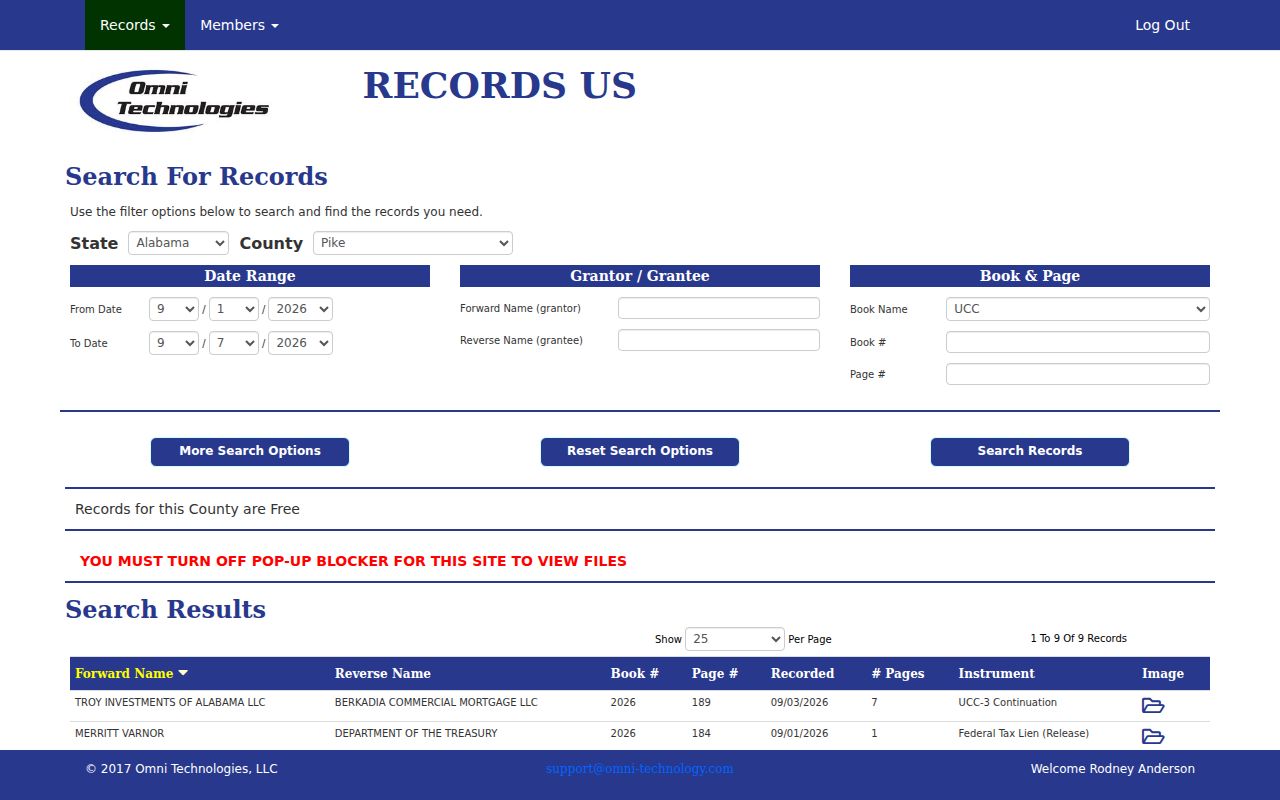
Expose only the fields your question needs. Then read the full instrument instead of trusting its result row.
Pike Plats and Legal Descriptions Beside Deeds
Match a subdivision deed to its recorded plat by subdivision, phase or part, lot, and block. Rural deeds instead use metes and bounds or section, township, and range, so preserve every bearing, distance, exception, easement, and prior citation. A CAMA map can orient the tract. It cannot replace recorded text or survey evidence.
Probate records plats. Revenue maps deeds, wills, and subdivisions after filing. That split explains why a parcel shape helps locate a deed in Pike County without controlling its legal boundary.
Fees Tied to Pike County Deed Records
Ala. Code §45-55-81 sets $5 per page for recording listed deeds, mortgages, liens, judgments, and lis pendens. Each instrument also carries a $2 special indexing charge. Those are filing charges, not necessarily copy fees. Alabama adds deed recordation tax of $0.50 per $500 or fraction. The state also imposes mortgage tax of $0.15 per $100 or fraction. Pike County's recording page lacks a complete fee schedule. Other sources conflict, so confirm current counter charges before filing. Use the deed or receipt to confirm consideration and stamps.
Pike Deeds Before the 1970 Selector
RecordsUS reaches back to 1970 at its earliest. Pike County does not promise complete online coverage from that year. Alabama Archives lists an 1828 courthouse fire. Ask which series were lost, copied, or reconstructed rather than assuming every early deed disappeared.
An indexed Deed Book A abstract spans 1826 through 1839. Other routes include Probate. ADAH county microfilm guides, Troy Public Library, Troy University Archives, and FamilySearch affiliate access can also help. Every archive clue should end at a surviving volume.
Keep a one-line ledger for each transfer. Record the date, Forward Name, Reverse Name, and instrument. Add book and page, legal description, stamps, prior reference, source, and next step. That structure turns an executor, trustee, foreclosure, partition, parcel split, or entity-name change into a visible transition. A missing owner stops being mysterious.
The 1828 fire is a question, not a conclusion. Put it to Probate and ADAH. Compare the Deed Book A abstract with microfilm guides. Check surviving books and recitals in later deeds. A later instrument may quote an older description even where the web index ends. The legal chain can stay continuous even when the online trail does not.
New Fraud Checks for Pike County Deeds
Alabama's Property Protection Act takes effect October 1, 2026. It targets seller-impersonation fraud. Pike County offers no alert signup yet. Until then, search recent records in both name directions, compare legal descriptions, and contact Probate about any unfamiliar filing. An index row is not a legal conclusion, so preserve the instrument and seek qualified help promptly if a transfer appears unauthorized.
Getting an Official Pike County Deed Copy
To obtain an official copy, view an available image online or call Pike County Probate at 334-566-1246. The counter sits in Room 41, 120 W Church Street, Troy, and keeps hours of 8 a.m. to 5 p.m. Monday through Friday. Before paying anything, ask about availability, plain versus certified pricing, and whether the office delivers by mail, fax, or email. The Probate contact form is another channel, and it states that response efforts are made within five business days.
A request citing Ala. Code §36-12-40 should identify the party names, the book and page, the instrument type, and the date. If you mail a request, first confirm the office accepts it. Ask what remittance method is current, and how certification must be worded. The public pages do not expose a complete mail or fax copy form. Name both parties, the citation, the date, the document type, and whether every page is required.
When only a name is known, do the online index work yourself. Send the best citation rather than asking staff to build a full chain. If an image will not open, mention the failed pop-up and the result details. For old records, state the date range and ask which book or microfilm index applies. The library, the local society, and ADAH serve as historical fallbacks.
Mortgages, assignments, satisfactions, judgments, lis pendens, and tax documents must each be requested as their own instruments. A deed can establish a recorded transfer while leaving separate encumbrance questions unresolved. Current title work has to address those related records and their releases.
At the counter, ask to see both the direct and reverse index for the period. Do so when a party-name search is incomplete. Bring alternate spellings, initials, former surnames, estate roles, and business suffixes. Platted land calls for the subdivision, phase, lot, and block. A farm or larger tract calls for section, township, range, bearings, and the closest known prior deed. These details turn a broad question into a request for identifiable public records.
A deed image may carry marital-status recitals, acknowledgments, reservations, exceptions, easements, and references to another instrument. Read the signature and notary pages, not just the first page. Compare the conveyed legal description with the parcel in question. A party may have recorded documents affecting more than one tract. Where the instrument cites a plat or separate easement, retrieve that record too. Keep a copy ledger with the source URL, image filename, date accessed, and certification status. Online images are useful working copies, but a certified copy from the custodian answers a different evidentiary need. If RecordsUS pagination or output settings hide a field, rerun the search with the needed checkbox. Do not infer the missing value.
Recorded does not mean guaranteed. Pike County deed records show filed instruments, not a title opinion. Unrecorded interests and other defects require certified records and qualified title work.